I first saw Cary Kwok's work in BUTT Magazine, and it gave me one of those "thank-god-someone-did-this" sensations (see the series "Cum to Barber").
Now Cary is part of the ICA's group exhibition "Keep your Timber Limber", where his sharp ballpoint pen drawings make jaws drop and steal the show hands down, including from Tom of Finland and Georg Grosz.
You see why.
Muscle Toss, 2010
Cum to Father, 2010
Buddjism, 2010
To see more of Cary's spunk, check out his website, or visit the ICA until 8 September.
Plates by Berlin-based Tulip collective. The tricksters take old granny crockery (see how the flowers were there before?) and add nudes and naughty wisdoms.
They make me think of the scene in the Birdcage where a dinner guests find "young men playing leap frog" on the china. Picnic with Auntie? Dinner with the in-laws? I want.
2. The Power of Queer
Speaking of vintage: the sacred band of thebes was an elite fighting troop in the 4th century B.C. consisting of 150 pairs of male lovers. The idea, attributed to Plato, is simple: when with boyf, you'll be courageous.
"And when
fighting at each other's side, although a mere handful, they would
overcome the world. For what lover would desert his beloved or fail him in the hour of danger?
You wish
Band Of Thebes also happens to be the name of one of the finest blogs on the world wide web. Every day, publishing executive Stephen Bottum writes about famous queers throughout the ages, with an emphasis on writers and creatives. Rewrite your history books.
3. Twenty Years Ago
Are you old enough to remember this? In 1993, Benetton put a massive condom over the Egyptian Obelisk at the Place de la Concorde in Paris. AIDS was the topic of the day back then. Need for a refresher?
Marketing or not, kudos to Benetton for raising awareness. And they haven't stopped since. Did you see the gay kiss campaign that was banned by the Vatican?
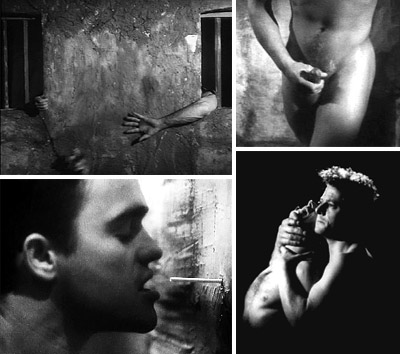
This week my friend, illustratorIris Hatzfeld, introduced me to the multi-talent that was Hervé Guibert. Raised in a Parisian bourgeois family, Guibert made a name for himself as a photographer, novelist, and critic.
Jeanne d'Arc, 1983
Major influences were proto-BeatnikJean Genet and close friend Michel Foucault. This is visible in much of Guibert's work, which is permeated by shadows (in all the senses of the term) and fragility. His is creation fuelled by an obsession with love and that curiously gay penchant for abjection.
"The secret of the other shall be my secret. And this face which stares at me can very well decompose: it is already dead."
Guibert died of AIDS in 1991, shortly after writing "To The Friend Who Did Not Save My Life" which changed France's opinion of the epidemic. Read an extract from his posthumously published journals The Mausoleum of Lovers here. It's like his photos: notions of happiness, obscured.
Men's fashion week in Paris, and Raf Simons does the unthinkable: making the biggest names in fashion take a bus to a banlieue. Suzy Menkes, Alaïa, Jeremy Scott (to name but a few) were packed into a tiny van that bore Raf's name, and driven to the drab outskirt of Le Bourget to the latest Gagosian gallery - a massive masterwork by Jean Prouvé. Inside, beautiful manorexic models strutted their stuff amongst Calder mobiles.
When I was 5 and in kindergarden I began to wonder whether I wasn't a bit of a grump. While the other kids laughed theirs heads off when our teachers put on puppet shows, I hardly raised the corners of my mouth.
About twenty years later I found myself in the same situation, going to see The Artist after everyone reassured me it was hilarious. I found it so boring I fell asleep. I concluded I didn't find things funny. Especially not silent films.
Which is why, I suppose, I steered off Charlie Chaplin. Until this week. Lonely and sick of words (aren't they everywhere? In books, on computer screens, on bilboards, in everyone's mouth including your own) I decided to give Mr. Chaplin a try.
I started with "The Kid." I laughed so hard laughter flew out of my window and resonated in the street. It contained relief (at not being a hopeless grump) and actual, sincere joy.
The Kid (1921), Charlie Chaplin, in Full
Elated by this discovery, I moved on to City Lights the same day (which happened to be showing at the Kino Kultura). It made me laugh at least as loud as the Kid, if not louder - since we often laugh harder in public (and cry more bitterly at home). That did not stop me from shedding crocodile tears at the end.
City Lights (1931), Charlie Chaplin, in Full
Returning home, I found The Great Dictator on my hard-disk drive. I loved it, despite the words (this one is not silent) and my German schooling. Even though the laughter came from a more desperate place, because this film is without doubt the most ridiculous and yet the most serious of the bunch.
The Great Dictator (1940), Charlie Chaplin, in Full
Serious or not, CC showed me in one day that I am no grumpy child. I love him for that. And I love his outfits too. So does John Galliano (definitely a grumpy child).
John Galliano - Charlie Chaplin inspired show, Spring/Summer 2011